
 back to overview
Museum Gotisches Haus
Museum Gotisches Haus
61350 Bad Homburg v. d. Höhe
Closed on Mondays (including public holidays)
Tuesday to Saturday, 2 – 5 pm; Sundays and public holidays, 12 noon – 5 pm
Schools and nurseries in Bad Homburg are granted free admission.
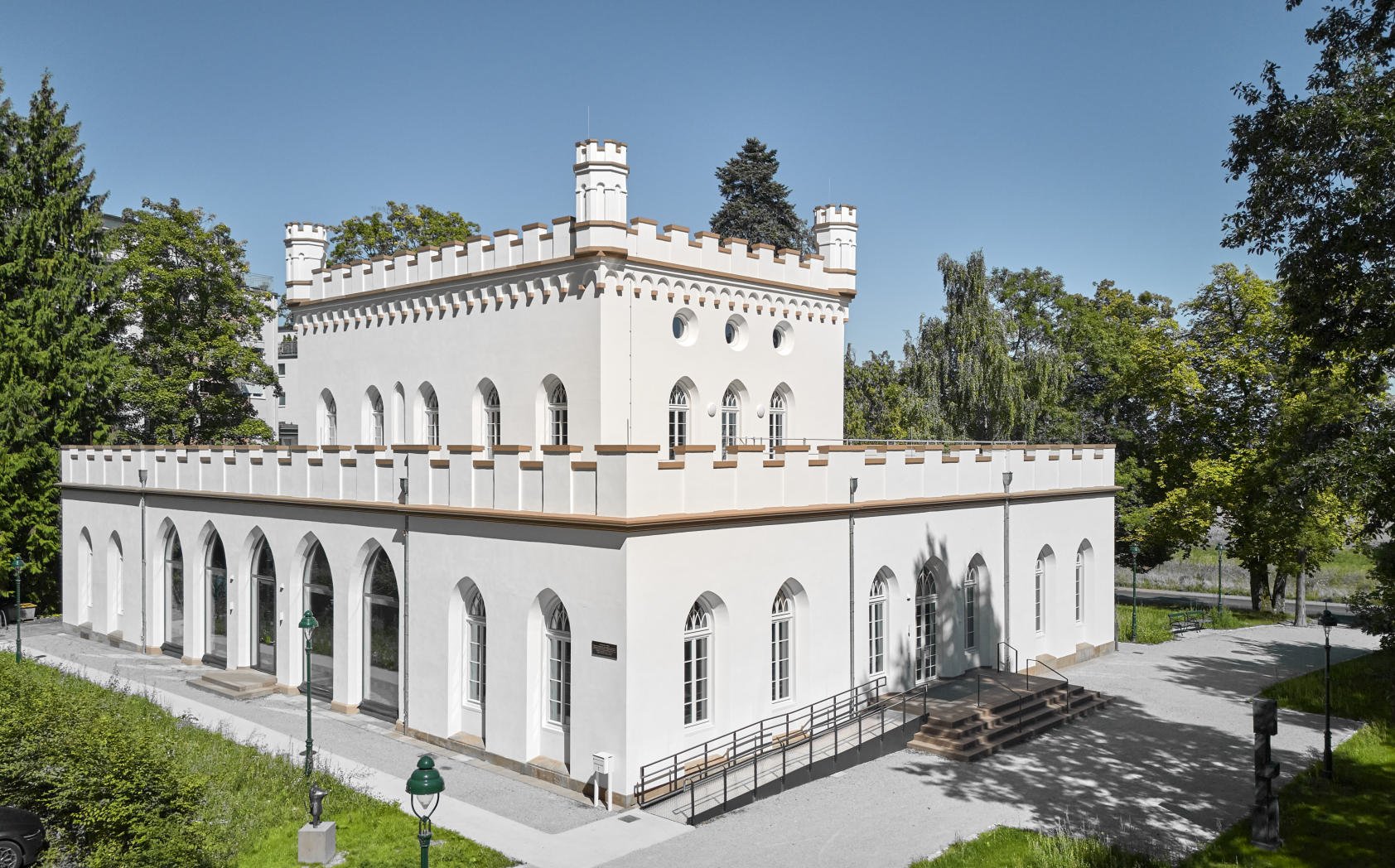
The Gothic House is a small hunting lodge built in 1823 on the orders of Landgravine Elizabeth for her husband, Landgrave Friedrich VI Joseph, on the edge of the Großer Tannenwald. Following the Landgrave’s death in 1829, it never came into use for its intended purpose and subsequently served a wide variety of functions. Its architecture was adapted several times to suit its changing uses, until it was completely destroyed by fire inside. Following an initial renovation in the 1980s, the exterior was restored as closely as possible to its original form. Inside, the fire had destroyed everything. A multi-storey concrete and brick structure replaced the former single-storey premises, which were divided into many separate rooms. In 1985, the Municipal Historical Museum, founded in 1916 and now known as the Museum Gotisches Haus, moved in. Its exhibitions focused on the collections relating to the local and regional history of Hessen-Homburg, as well as exhibits on cultural and art history. Special sections included a coin cabinet, the ‘Marienbader Stube’ and the so-called ‘Hat Museum’, all of which were established after 1945. In 2020, the Gothic House was closed for further renovation. During the closure of the Gothic House, 40,000 objects from the collection remained temporarily accessible to the public at all times in the ‘display depot at the Horex Museum’. Until then, the Horex Museum had displayed the part of our collection covering industrial history and, in particular, the history of mobility. The renovation of the Gothic House was completed in autumn 2025. It was fitted with an additional staircase, brought up to the latest technical standards and made climate-neutral. Furthermore, the exterior façade retains the historical stylistic features of Tudor Gothic architecture. It is unique on the European mainland, where ‘Gothic Houses’ in English landscape gardens (see Pushkin, Puławy or the Dessau-Wörlitz Garden Realm) draw on German Gothic architecture, sometimes combined with other styles. Thus, the façade design of our Gothic House and the layout of the pathways once again correspond to the original plans of Landgravine Elizabeth. Its interior remains a functional building, where the latest museum technology will help to preserve the precious and often very fragile objects, crafted from a wide variety of materials, for future generations. In future, all areas of the collection will be exhibited in the Gothic House in regularly changing displays. Special exhibitions will explore the individual collection areas in greater depth.